
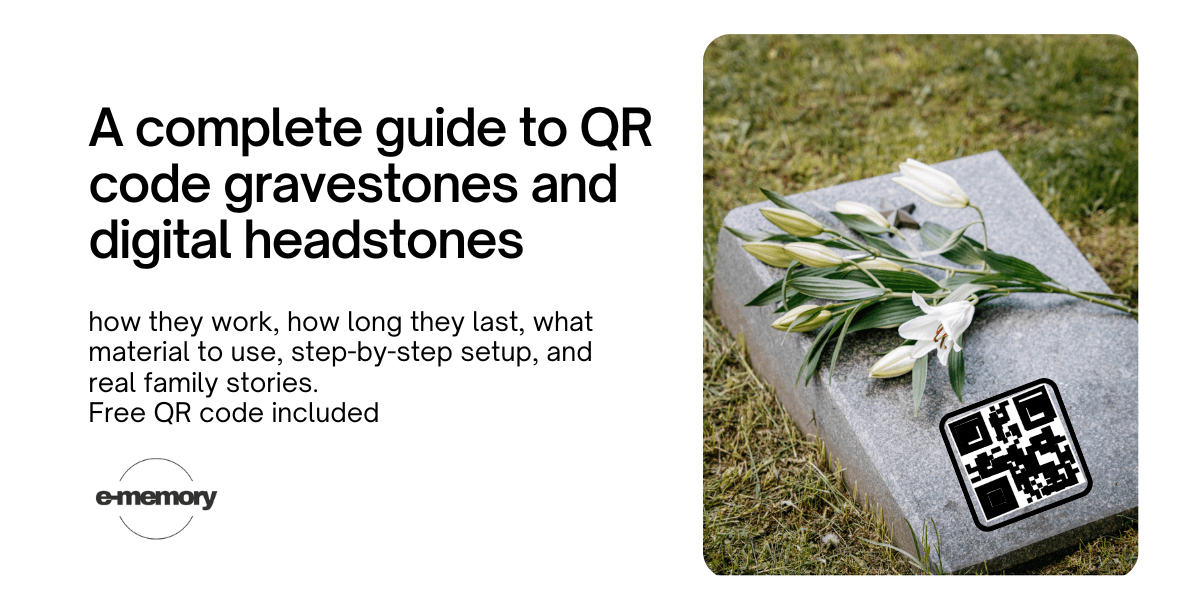
The short answer: A QR code gravestone works by placing a small scannable code — either engraved, printed on a weatherproof plaque, or applied as a sticker — on a headstone or memorial object. When a visitor scans the code with any smartphone, it opens a memorial page containing the person's photographs, life story, favourite music, and family memories. No app is required. It works on any phone made in the last decade.
This is the complete guide: what a digital headstone is, how families are using QR codes today beyond the grave, how long they last, what material to print or engrave them on, how much it costs, and how to create one for free in under five minutes.
What a QR Code Gravestone Actually Is
A QR code headstone — sometimes called a digital headstone or smart grave marker — is a traditional grave marker with one addition: a scannable code linked to a living digital memorial. Where a conventional headstone shows a name, two dates, and perhaps a short epitaph, a digital headstone opens a door.
The code itself is small — roughly the size of a postage stamp when printed at minimum size, though larger engravings are more legible and more durable. What it contains is not small at all. Scan it, and you step into a life: photographs spanning decades, stories written by people who loved them, the music they listened to on Sunday mornings, the voice they had.
The idea emerged from a simple observation: a headstone tells you that someone lived. A QR code memorial tells you how.
This is not a niche technology or a futuristic concept. As of 2026, QR code memorials are used in cemeteries across Europe, North America, and Australia. Funeral directors are being asked about them regularly. Cemetery associations in several countries have updated their guidelines to accommodate them. Families who have used them describe the same experience: visitors who expected to stand quietly at a grave end up sitting on the grass for an hour, watching videos and reading stories they had never encountered.
How It Works: Scan → Memorial Page → Full Life Story
The technical process is simpler than most people expect.
Step 1: A QR code is generated from a memorial page link — a unique web address that belongs to the memorial page you have created. The QR code is a visual representation of that link. Any smartphone camera, pointed at the code for a moment, reads it automatically and opens the page in the phone's browser.
Step 2: The visitor arrives at the online memorial page. They do not need an account, an app, or a password. The page is designed to be immediately readable — the person's name, photograph, and dates visible within seconds of the page loading.
Step 3: From there, the page unfolds. Photographs. A written biography. Stories contributed by family members and friends. Favourite music, playing softly. A timeline built from social media archives, showing the person's life in their own words and images. A guestbook where visitors can leave their own memories.
The entire experience takes place on the phone the visitor already has in their pocket. There is nothing to download, nothing to sign up for, nothing to pay.
A memorial QR code is, in this sense, a bridge: between the physical place of remembrance and the digital life the person actually lived. Between the stone that marks where they are buried and the story of who they were.
How Families Are Using QR Codes Today
The gravestone is the most visible application of QR code memorials, but families have found that memory does not live only in cemeteries. The same code that appears on a headstone can appear anywhere the person's memory lives — and often the places that matter most are not a cemetery at all.
Here is how families are using memorial QR codes in practice:
On the gravestone or grave marker. The code is engraved directly into the stone, applied as a weatherproof stainless steel plaque, or attached as a UV-resistant ceramic tile. Visitors to the QR code cemetery scan the code and access the full memorial without needing to know the person's name or find an online search.
Inside a photo frame. A framed photograph of the person, displayed on a mantelpiece or in a family home, with a small printed QR code adhered to the back of the frame or to the glass. Anyone who picks up the frame can scan the code and see hundreds of photographs, not just the one they are holding. This is one of the most common uses of QR code photo frame memorials.
On a memorial candle. A printed label with the QR code, attached to a candle that is lit on anniversaries, birthdays, and holidays. Families report that the combination of the physical ritual of lighting a candle and the digital access to the person's memorial page is particularly moving. The memorial QR code candle has become a meaningful gift among families who want to give something personal rather than flowers.
In a favourite book. Inside the front cover of the book the person was reading when they died, or their all-time favourite, or the one they read every year. Anyone who opens the book finds the code and, from the code, finds a life.
At the funeral service or memorial event. Printed on the order of service, so that everyone who attends leaves with access to the memorial page. Family members who could not attend the service in person can scan the code from a photograph of the program and access the same memorial as the people who were there.
On a memorial bench or tree. Families who commission a memorial bench in a park or plant a memorial tree often add a small plaque with a QR code — a smart grave marker for spaces that are not cemeteries at all.
How Long Do QR Code Memorials Last?
This is the question that matters most, and it deserves a direct answer.
A QR code itself is permanent. The code is a static image — a pattern of black and white squares — that does not degrade or expire. A QR code engraved in granite in 2026 will still be scannable in 2046, provided the engraving is maintained and the squares remain legible.
What the QR code points to is the variable. It links to a URL — a web address — and that URL must remain active for the scan to open a page. This is the legitimate concern that families and cemetery managers raise, and it is worth addressing without evasion.
The risk with free, generic QR code generators is real. If you create a QR code using a free online tool that hosts the redirect on its own servers, the code will stop working if that company closes, changes its pricing model, or discontinues its free tier. This has happened. Families have visited graves and found the code no longer leads anywhere.
The approach that protects against this is to link the QR code to a memorial page that is hosted by a platform specifically built for permanence — one whose business model is tied to keeping those pages accessible for decades, not one that generates QR codes as a side feature of an unrelated service.
E-Memory generates QR codes that are linked to memorial pages hosted on infrastructure designed for long-term preservation. The memorial page address — and therefore the QR code linked to it — does not change. There are no subscription cliffs that delete your page if you stop paying. The core memorial page persists.
The practical lifespan of the physical code depends on the material. An engraved stone or stainless steel QR code, properly maintained, will remain scannable for fifty years or more. A printed paper sticker will not survive a wet winter. The material choice matters as much as the digital infrastructure behind it — more on that in the next section.
How to Generate a Memorial QR Code (Step-by-Step)
Creating a memorial QR code with E-Memory takes less than five minutes.
Step 1 — Create or open your memorial page
Go to e-memory.com and create a memorial page for your loved one, or log in if the page already exists. The QR code is linked to the page's unique web address, so the page must exist before the code is generated.
Step 2 — Go to page settings and select "Get QR code"
From the memorial page dashboard, click the settings icon and select "QR Code." E-Memory generates a unique QR code linked permanently to that memorial page.
Step 3 — Download the QR code image
Download the code as a high-resolution image file (PNG or SVG). The SVG format is preferable if you are sending it to an engraver or printer, as it scales to any size without losing quality.
Step 4 — Choose how to use it
For a gravestone or plaque: Send the SVG file to a stonemason or memorial company for engraving or plaque production. Most professional engravers accept digital files directly.
For a photo frame, candle, or book: Print the PNG file on a home printer or at a print shop. Laminate it or use waterproof label paper for any placement that will be exposed to weather or moisture.
For a funeral service program: Place the QR code image in the design of the order of service alongside the person's photograph.
Step 5 — Test the code before permanent installation
Before committing to engraving, print the code and scan it with at least two different phones to confirm it works correctly. Check that the memorial page loads quickly and displays as intended. This takes thirty seconds and prevents an expensive mistake.
What Material to Print or Engrave QR Codes On
The durability of a QR code grave marker depends almost entirely on the material it is applied to. Here is an honest guide.
Engraved stone (most durable). A QR code carved directly into granite, marble, or slate is the most permanent option. Professional stonemasons use laser engraving to reproduce the pattern with the precision required for scanning. The code will remain legible for decades with normal maintenance. Cost varies by mason, but typically ranges from £50–£200 / $60–$250 for the engraving addition to an existing headstone.
Stainless steel or bronze plaque (highly durable). A laser-engraved metal plaque attached to the headstone with weatherproof adhesive or fixings. Stainless steel is the most resistant to corrosion. Bronze is traditional and ages gracefully. Plaques can be ordered from specialist memorial suppliers and arrive ready to attach. Cost: £30–£120 / $40–$150 depending on size and material.
Ceramic tile (very durable). A UV-printed ceramic tile with the QR code baked into the glaze. Ceramic is weather-resistant, visually attractive, and can include colour — a photograph beside the code, for example. Suitable for graves, memorial benches, and interior display. Cost: £20–£60 / $25–$80.
Weatherproof vinyl sticker (moderate durability). A high-quality UV-resistant vinyl sticker with the QR code printed in waterproof ink. Suitable for sheltered positions — inside a frame, on a candle, on an indoor surface. Not recommended for long-term outdoor use without additional protection. Will typically last 2–5 years outdoors before fading or peeling. Cost: under £5 / $6 for home printing on appropriate media.
Paper print (temporary only). A home-printed paper QR code is suitable for a funeral service program or a temporary indoor placement. It will not survive weather or time. Use it as a starting point while a permanent solution is arranged, not as the permanent solution itself.
Cost: Free QR Code vs. Professional Engraving
The QR code itself is free on E-Memory. Generating the code, downloading it, and using it however you choose costs nothing.
The cost, if any, comes from the physical production — the engraving, the plaque, the ceramic tile. Here is a clear breakdown:
Application | DIY Cost | Professional Cost |
|---|---|---|
QR code generation | Free | Free |
Home-printed sticker | Under £2 / $2 | — |
Weatherproof vinyl label | £3–£8 / $4–$10 | — |
Ceramic tile | £20–£40 DIY kit | £30–£60 ordered |
Stainless steel plaque | — | £40–£120 / $50–$150 |
Stone engraving | — | £60–£200 / $70–$250 |
Funeral program print | Under £1 / $1 per copy | Print shop rates |
A family that wants a permanent QR code headstone addition should budget £80–£200 / $100–$250 for the physical production, with the digital memorial itself free. A family that wants a QR code on a candle or photo frame for home use can do it for under £5 / $6.
A Real Story: The Veteran Whose QR Code Let Guests Hear His Voice
At a memorial service for a veteran who had served for twenty-two years, his family placed a QR code on every order of service. The code linked to his E-Memory memorial page, which included a recording of an interview he had given to a local history project the year before he died — forty minutes of his own voice, in his own words, describing his service, his family, and what he thought about the world.
Guests at the service who scanned the code found themselves listening to him speak. People who had known him for decades heard stories they had never heard. His grandchildren, the youngest of whom was four, heard his voice for the first time.
His daughter later described it as "the thing that made the service feel like him rather than just about him."
The recording had existed on a hard drive for a year, known only to the person who conducted the interview. The QR code made it accessible to everyone who cared about him, in the moment they most needed it, without any technical knowledge on their part.
This is what a digital headstone makes possible: not a replacement for physical remembrance, but an expansion of it.
Frequently Asked Questions
Will the QR code still work in 20 years? The code itself — the physical pattern of squares — does not expire. Provided it is engraved or printed on durable material and remains legible, it will be scannable in 20 years. The page it links to must also remain active. E-Memory's memorial pages are designed for permanence: they do not expire with a subscription, and the page address linked to your QR code does not change.
What if E-Memory shuts down — will the memorial disappear? This is a legitimate concern and one we take seriously. E-Memory's business model is built around memorial permanence as a core value, not as a feature. We maintain redundant infrastructure and are committed to providing families with data portability — meaning you can export all content from your memorial page at any time. In the unlikely event of a service closure, we are committed to giving families adequate notice and the tools to migrate their content.
How big does the QR code need to be to scan reliably? A minimum of 2.5 cm × 2.5 cm (1 inch × 1 inch) for close-range scanning in good light. For outdoor use or engraving, 4 cm × 4 cm (1.5 inches × 1.5 inches) is more reliable and more forgiving of wear over time. Larger is always better for durability and accessibility.
Can a QR code be added to an existing headstone? Yes. A stonemason can add a laser-engraved QR code to most existing headstones, or a weatherproof plaque can be attached. Cemetery rules on additions to existing stones vary — always check with the cemetery office before commissioning any work on an existing grave marker.
Do you need a smartphone to scan a QR code? Any smartphone made after 2017 with a standard camera app can scan a QR code without downloading anything. Older phones may need a free QR scanner app. The memorial page itself works on any phone with a browser and a data connection — no account, no download, no password.
Can the QR code link be changed after the code is printed or engraved? No — and this is a feature, not a limitation. The QR code is a fixed image of a fixed link. Changing the code would require a new print or engraving. However, the memorial page itself can be updated at any time without changing the code. Adding new photographs, new stories, new music, new contributors — all of this updates the page that the existing code links to. The code stays the same; the page behind it grows.
What if someone at a cemetery doesn't have mobile data? QR code scanning requires an internet connection to open the memorial page. In most cemeteries, mobile data is available. For visitors who do not have data access, the page can also be bookmarked or accessed later via the personal link, which works on any device with an internet connection.
Is a QR code headstone allowed in all cemeteries? Cemetery rules vary significantly by country, region, and individual cemetery policy. Many cemeteries now explicitly permit QR code additions; others require approval for any modification to an existing stone. Always confirm with the cemetery office before commissioning any work. Most cemetery managers are increasingly familiar with the request and have a clear process for approving it.
Create Your Memorial QR Code — Free
A name. A photograph. A story.
That is what a QR code memorial holds — not data, not files, but the specific and irreplaceable shape of a person's life, accessible to anyone who stands at a grave, opens a book, or picks up a candle and wonders who this person was.
The code is free. The page is free to create. The decision to begin is the only thing that costs anything, and it costs less than you think.
→ Create your free memorial page and generate your QR code
E-Memory is a digital memorial platform that creates living memory pages for the people you love — complete with photographs, life stories, favourite music, and a unique QR code that can be placed anywhere memory lives. Free to start. Built to last.
