
Somewhere on a phone you haven't charged in two years, there is a video of your father laughing. Not posing for a photo — laughing, the real kind, the kind that made his whole face change. You don't remember taking it. You almost certainly don't remember what was funny. But it is there, fragile as a breath, waiting for the day the battery finally gives out or the cloud subscription lapses and it disappears forever.
This is the quiet crisis no one talks about at the funeral.
We live more of our lives online than any generation before us — our photographs, our opinions, our inside jokes, our late-night check-ins and Sunday morning posts. And yet, when someone we love dies, all of that digital life sits in an awkward limbo: sometimes accessible, sometimes locked behind passwords, always at the mercy of a platform's terms of service and the slow entropy of servers that don't care about memory.
It doesn't have to be this way.
The Digital Legacy Problem Nobody Prepared Us For
Meta announced in early 2025 that Facebook Live videos would be deleted after just 30 days — a quiet policy change that most families will only discover after it is too late. Instagram accounts can be memorialized or removed, but the process requires documentation, patience, and bureaucratic navigation that feels obscene during active grief. Google's Inactive Account Manager requires the deceased to have set up access before they died. Most people never did.
We inherited a digital world and no one taught us how to grieve inside it.
The "Death Tech" industry is now projected to reach nearly $22 billion, and over 1.7 million digital funeral events take place globally every year. Families are waking up to the reality that a life lived online deserves to be honored online — not left to the mercy of deletion notices and privacy policies.
But here is what the industry mostly gets wrong: it treats digital memorialization as a product category inside the funeral business. It thinks about headstones and cremation and service planning. It does not think about the video of your father laughing.
Memory Is Not a Stone. It Never Was.
Walk into any home where someone has recently been lost, and you will find the same scene: a kitchen table covered in printed photographs, people scrolling through phones trying to find that picture, someone saying "I think it's on Facebook somewhere" while someone else checks an old email for a scanned image from 1987.
Memory is scattered. It always has been. What has changed is where it lives — and how fragile those places have become.
Online memorials have evolved into interactive digital legacies. While physical tributes can fade over time, a well-chosen online memorial can preserve memories for future generations — transforming a collection of memories into a living, accessible archive of a life.
That word — living — is the one that matters. Not a static obituary. Not a frozen profile. A living memorial is one that grows, that gathers, that connects the people who loved someone into a single place where their story continues to breathe.
This is the idea at the heart of E-Memory.
What a Digital Family Archive Actually Looks Like
We did not build E-Memory to be a product in the funeral industry. We built it to be something closer to what families actually need when someone they love is gone: a beautiful, permanent, accessible home for a human story.
It works like this.
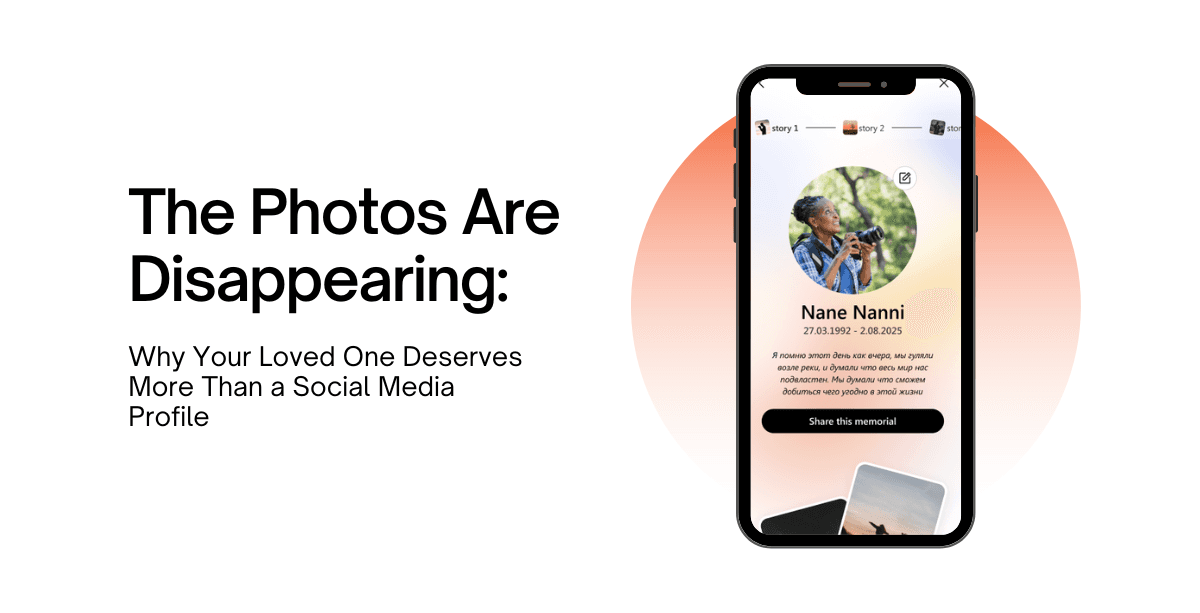
You create a memorial page for your loved one. You add what you have — a photograph, a date, a sentence about who they were. That is enough to begin. From there, the page becomes a gathering point. Family members in three different time zones can add their own photos, their own memories, their own piece of the story. A cousin from Melbourne contributes a story from 1998. A childhood friend uploads a photo from a summer neither of you remembered clearly until you saw it again.
Family and friends can contribute stories, upload photographs, and share videos, creating a collaborative tapestry that celebrates the individual's life in a comprehensive and interactive way. With families often spread across different locations, an online memorial provides a space where everyone can come together to mourn, celebrate, and remember.
But E-Memory goes further than a memorial website. It reaches into the digital life your loved one already built and rescues it.
Rescuing What Already Exists
Most of us have spent fifteen years building a digital life without realizing it. Every tagged photo, every check-in, every birthday message received and given — it forms a portrait of a person more complete and more human than any obituary could be.
E-Memory lets you upload your Facebook or Instagram data export and transforms it automatically into a family life timeline — a chronological, beautiful story of someone's existence. Not a database dump. Not a folder of files. A narrative. The kind you want to sit with on a Sunday afternoon and actually read.
A "download" of social media data should be treated as one layer of preservation — not the only layer. If a specific video, caption, or comment thread matters deeply to your family, it can be wise to save it in more than one way. E-Memory becomes that second layer — the one that is organized, permanent, and built for human beings rather than for data formats.
The result is what we call a digital family archive: a living record of a person's story that does not require a password to access, does not expire with a subscription, and does not disappear when a platform decides to change its policies.
The QR Code That Lives Everywhere Memory Lives
Here is something worth sitting with: memory does not live in one place.
It lives in the cemetery on a Tuesday afternoon. It lives in the favourite armchair, in the kitchen where someone used to cook, in the book they were reading when they died. It lives at the holiday table and in the car on long drives when a song comes on and nobody speaks for a moment.
A QR code memorial - a small, printed code linked to a full memorial page — understands this. You print it and place it where the memory already lives:
Inside the cover of a loved one's favourite book
On a framed photograph on the mantelpiece
On a candle lit each anniversary
On a headstone, so that anyone who visits can hold up their phone and step inside an entire life rather than reading two dates separated by a dash
During a service for a veteran, a family placed a QR code on the program. Scanning it took guests to a virtual memorial where they could listen to a recorded interview of the deceased discussing his service — a powerful way to hear his voice one last time.
This is what it means to preserve memories online in a way that is genuinely useful - not just technically possible. The memorial page is not somewhere you go once. It is somewhere you return to, again and again, as the grief changes shape and the gratitude grows.
Gentle Reminders for the People Who Loved Them
Grief does not follow a calendar. But some dates arrive with a particular weight.
A birthday. An anniversary. The date they died. The date they got married. The day they came home from hospital the first time and everyone thought everything would be different.
E-Memory holds those dates and, when they come, sends a quiet message: Today is your father's birthday. Would you like to look at his favourite photos? Not a notification demanding your attention. An invitation. A hand on the shoulder.
Because the truth about grief is that forgetting does not hurt less than remembering. Both carry their own kind of ache. What helps is having somewhere to go — a place that holds the person you are missing, ready to receive you on whatever terms you arrive.
This Is Not About Death. It Is About Life.
There is a particular discomfort that surrounds digital memorial platforms. People assume they are part of the funeral industry, which means they assume they are grim.
They are not.
Walk through E-Memory and what you find is not an industry. What you find is a grandmother's voice in a video from 2009, slightly out of focus because nobody knew how to hold a camera phone. You find a father's handwriting in a post he wrote the year his daughter graduated. You find the comments beneath a photo - the friends, the cousins, the neighbours - all of them saying things they meant, in a language that is still fresh, still present tense, because the internet does not know that someone died.
These platforms serve as a central, accessible place for comfort, community, and the preservation of a legacy. They offer a unique form of solace that a physical monument alone sometimes cannot provide.
We are not part of the funeral industry. We are part of the life industry — the business of insisting that a human being's story matters enough to be kept properly, presented beautifully, and protected permanently.
Family heritage is not something you find only in genealogy archives or faded letters in attic boxes. It is in the photograph taken at a birthday dinner. It is in the comment someone left on a post in 2014. It is in the song someone listed as their favourite, the one that plays now whenever you want to feel close to them.
How to Create a Memorial Page: It Takes Three Minutes
We want to say something plainly that the grief industry rarely says plainly: this does not have to be hard.
Creating a memorial page on E-Memory takes about three minutes. You do not need to be organized. You do not need to have all the photographs ready. You do not need to know what to write.
You start with a name and a face. The rest comes when it comes — when your sister adds a story from childhood you had forgotten, when your mother uploads a photo you have never seen, when a friend from forty years ago finds the page and writes three sentences that make everything feel, just for a moment, less impossible.
The page grows the way memory grows: slowly, unevenly, with unexpected gifts from people who loved the same person from a completely different angle.
What We Owe the People Who Shaped Us
There is a phrase we return to often, inside the walls of E-Memory: their story doesn't end here.
It is not wishful thinking. It is a genuine conviction about what happens when a human life is honored properly - when its photographs are gathered, its stories are told, its voice is preserved in whatever form it still exists.
Stories do not end. They change address. They move from the person who lived them into the people who carry them, and from those people into the children who will one day ask questions about someone they never met but somehow already know.
The design of digital memorial platforms has profound implications for how we grieve and remember. Organizations like the Digital Legacy Association emphasize that control and access are paramount for grieving families.
E-Memory exists because we believe that the families doing this work — the ones quietly gathering photographs at kitchen tables, trying to rescue videos from platforms before the deadline — deserve a tool built for them. Not for the funeral home. Not for the industry. For the sister who cannot sleep and keeps opening old texts. For the son who still has his mother's voice on a voicemail and doesn't know what to do with it.
For all of us who are trying to hold onto something that mattered.
Start Today
You do not need to wait for the right moment. There is no right moment for this kind of work. There is only the moment when you decide that the story of someone you love is worth keeping properly.
Create a memorial page for free at e-memory.com
It takes three minutes. The memory lasts forever.
E-Memory is a digital family archive and living memorial platform. We help families gather, preserve, and share the stories of people they love — through memorial pages, QR codes, family timelines, and gentle reminders that keep memory alive across generations.
